
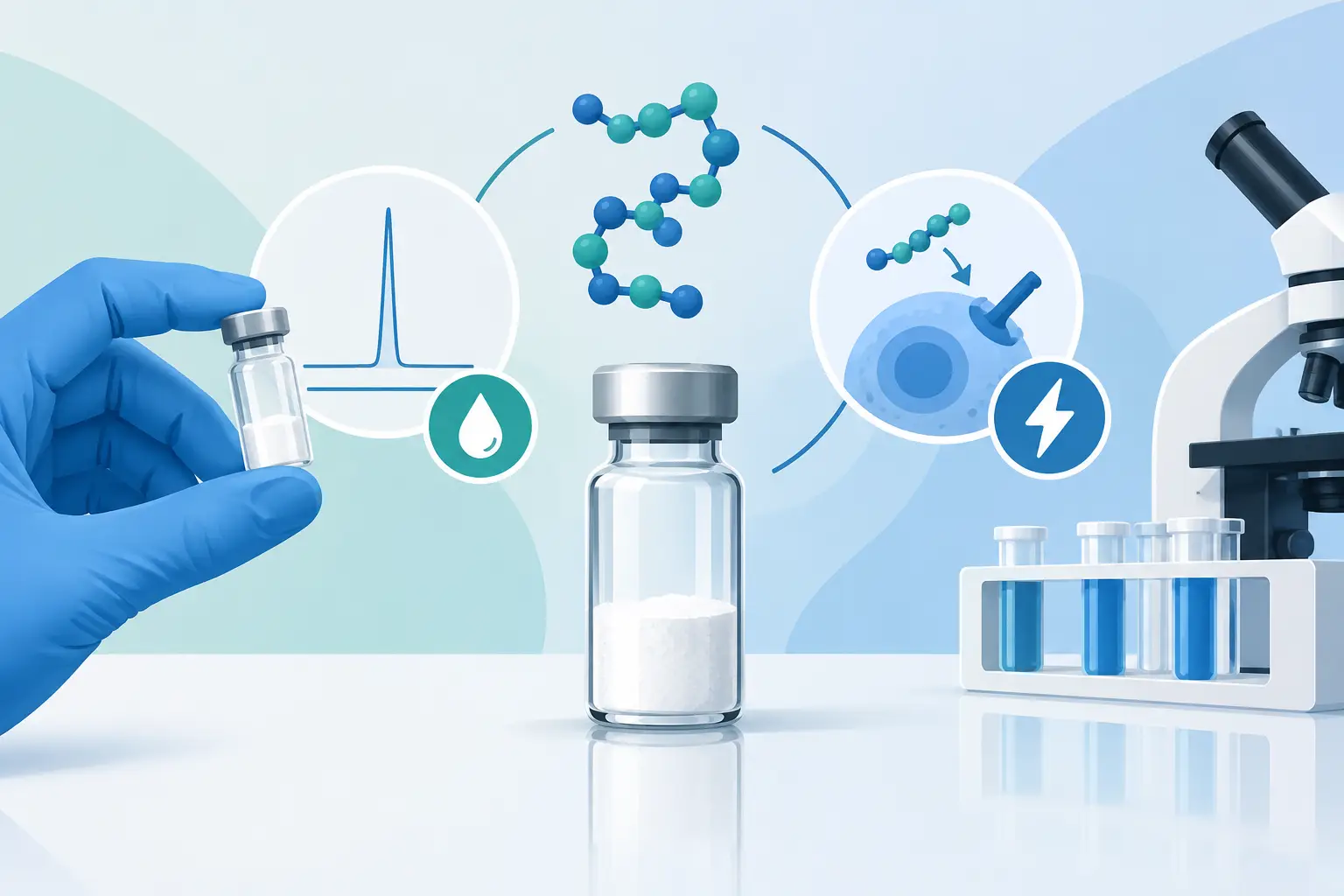
A vial labeled 99%+ purity can be a strong starting point for a research program, but it does not automatically answer every question about experimental performance. Peptide purity versus potency is a distinction that affects method selection, documentation review, lot acceptance, and how confidently a result can be interpreted.
For qualified researchers, the practical objective is not to choose one metric over the other. It is to understand what each measurement demonstrates, where its limits are, and which evidence is appropriate for the intended research application. A clear certificate of analysis, lot-specific identity data, and controlled storage practices create a much more defensible quality picture than a purity percentage alone.
Peptide Purity Versus Potency: Different Questions
Purity asks a compositional question: how much of the material in the sample corresponds to the intended peptide relative to detectable related substances or impurities? It is commonly expressed as a percentage, often based on chromatographic peak area. A stated 99%+ purity specification generally indicates that the primary peptide peak accounts for at least 99% of the measured chromatographic area under the stated test conditions.
Potency asks a functional question: how much biological or analytical activity does a material produce in a defined assay system? Depending on the compound and research context, that may involve receptor binding, enzyme activity, cellular response, or comparison against a qualified reference material. Potency is inherently assay-dependent. A result obtained in one laboratory, on one cell line, with one protocol, cannot be assumed to apply universally.
The difference matters because a sample may show high chromatographic purity while still producing unexpected results in a functional assay. The reverse can also occur: a sample with a lower apparent purity result may retain measurable activity, although that does not make it suitable for all research purposes. Purity supports confidence in composition. Potency supports confidence in a specific measured function. Neither replaces the other.
What a Purity Result Actually Tells You
High-performance liquid chromatography, often called HPLC, is widely used to evaluate peptide purity. In a typical analysis, components in the sample separate based on their interaction with the chromatographic system. The primary peak is assessed alongside smaller peaks that may represent deletion sequences, synthesis byproducts, degradation products, or other related impurities.
A 99%+ HPLC result is valuable, but researchers should read it in context. Peak-area purity is not always the same as absolute mass purity. Detector response can vary among compounds, and the reported result depends on the analytical method, wavelength, integration settings, sample preparation, and acceptance criteria. A meaningful COA identifies the method used and ties the result to a specific lot.
Mass spectrometry provides a complementary form of evidence. While HPLC helps separate and estimate relative purity, mass spectrometry helps confirm that the principal molecular species has the expected molecular weight. Together, chromatographic and mass data provide stronger support for identity and composition than either result viewed alone.
Purity data also do not fully describe material attributes such as residual water, counterion content, salt form, or peptide content by mass. Those factors may matter when a protocol requires a highly controlled material balance. Researchers working under validated methods or comparing results across sites may need additional specifications beyond an HPLC purity percentage.
Common sources of confusion
The phrase “99% pure” can sound absolute, yet every analytical result is bounded by a method and a measurement system. It does not mean 99% of every vial is necessarily active material by weight, nor does it guarantee freedom from every contaminant at every possible detection level.
It also should not be confused with sterility, endotoxin status, or suitability for any particular application. These are separate quality attributes requiring separate methods and specifications. Documentation should state what was tested rather than inviting assumptions about tests that were not performed.
What Potency Testing Adds
Potency testing measures a defined effect under defined conditions. For a peptide with known receptor interactions, an assay may report relative activity compared with a reference standard. For another research compound, a validated binding or cell-based assay may be the relevant approach. The details matter: incubation time, reagent lot, instrument calibration, cell passage, assay controls, and data-analysis model can all influence the outcome.
That is why potency claims require more context than a single percentage. A useful potency result identifies the assay type, reference material, acceptance range, and, where applicable, the unit of activity. Without that information, a broad activity statement may have limited value for a laboratory evaluating reproducibility.
Potency is especially sensitive to handling. Repeated freeze-thaw cycles, exposure to moisture, excessive heat, light, unsuitable solvents, or extended time in solution can affect peptide integrity and assay behavior. Even when a material was tested at release, the condition of the sample at the time of use remains part of the experimental equation.
For research-use-only materials, potency testing may not be available or appropriate for every catalog item. Some compounds lack broadly standardized functional assays, while others require specialized methods that do not translate cleanly between laboratories. In those cases, well-supported identity, purity, and contaminant-screening documentation may be the more practical purchasing criteria.
How to Read a COA Before Accepting a Lot
A certificate of analysis is only useful if it is connected to the material in hand. The lot number on the vial or packaging should match the lot number on the document. Review the report date, product name, stated specification, test result, and the laboratory or testing source responsible for the analysis.
For peptide research materials, look first for identity confirmation and purity data. If the supplier states 99%+ purity, the COA should show an actual result for the relevant lot rather than a generic specification. Chromatogram availability, test-method information, and molecular-mass confirmation further improve traceability.
Contaminant screening claims should be equally specific. Heavy-metal testing, for example, should indicate the analytes or panel tested, the method or reporting approach, and the result relative to a stated limit. A general statement that a product is “tested” is less informative than lot-level documentation that shows what was evaluated.
Researchers should also distinguish between a manufacturer document and independent third-party testing. Both can contribute useful information, but they answer different due-diligence questions. Third-party testing provides an additional layer of separation between production and verification. It does not eliminate the need to assess whether the method and reported parameters fit the planned work.
Building a Fit-for-Purpose Purchasing Standard
The right level of documentation depends on the experiment. A preliminary analytical method-development project may prioritize identity confirmation, high purity, and consistent lot tracking. A study comparing responses across multiple batches may require retention samples, tighter handling controls, and a documented plan for lot-to-lot comparability. Work conducted in a regulated or highly controlled environment may require specifications that exceed standard catalog documentation.
A practical intake review should cover five areas:
- Lot-specific COA availability and lot-number matching.
- Identity evidence, such as expected molecular mass.
- Purity result, method context, and stated acceptance specification.
- Relevant contaminant-screening documentation.
- Packaging, storage guidance, shipping conditions, and chain-of-custody records.
This review is not paperwork for its own sake. It helps prevent a common research problem: treating a purchasing label as though it were complete experimental characterization. Materials should be qualified against the demands of the method, not simply against the most prominent claim on a product page.
Storage and Handling Protect the Quality You Bought
Quality verification does not end at checkout. Once received, inspect packaging, confirm the lot number, preserve accompanying documentation, and record receipt conditions according to laboratory procedures. Store unopened material as directed by the supplier and limit unnecessary exposure to conditions that can compromise stability.
When preparing samples for research, use appropriate laboratory-grade consumables and follow a controlled preparation record. Label aliquots clearly, document solvent and concentration calculations, and avoid repeated handling of the full stock when aliquoting is feasible. If unexpected analytical or functional results emerge, retained documentation and a traceable handling record make troubleshooting far more efficient.
Prime Fit Lab presents research-use-only products with lot-focused quality information, stated 99%+ purity standards, and COA access to support this type of evaluation. Researchers should still confirm that the available documentation fits their protocol before adding any material to a study.
The most useful question is not whether purity or potency matters more. Ask what evidence your next experimental decision requires, then select and handle the material in a way that lets the data answer it with confidence.