
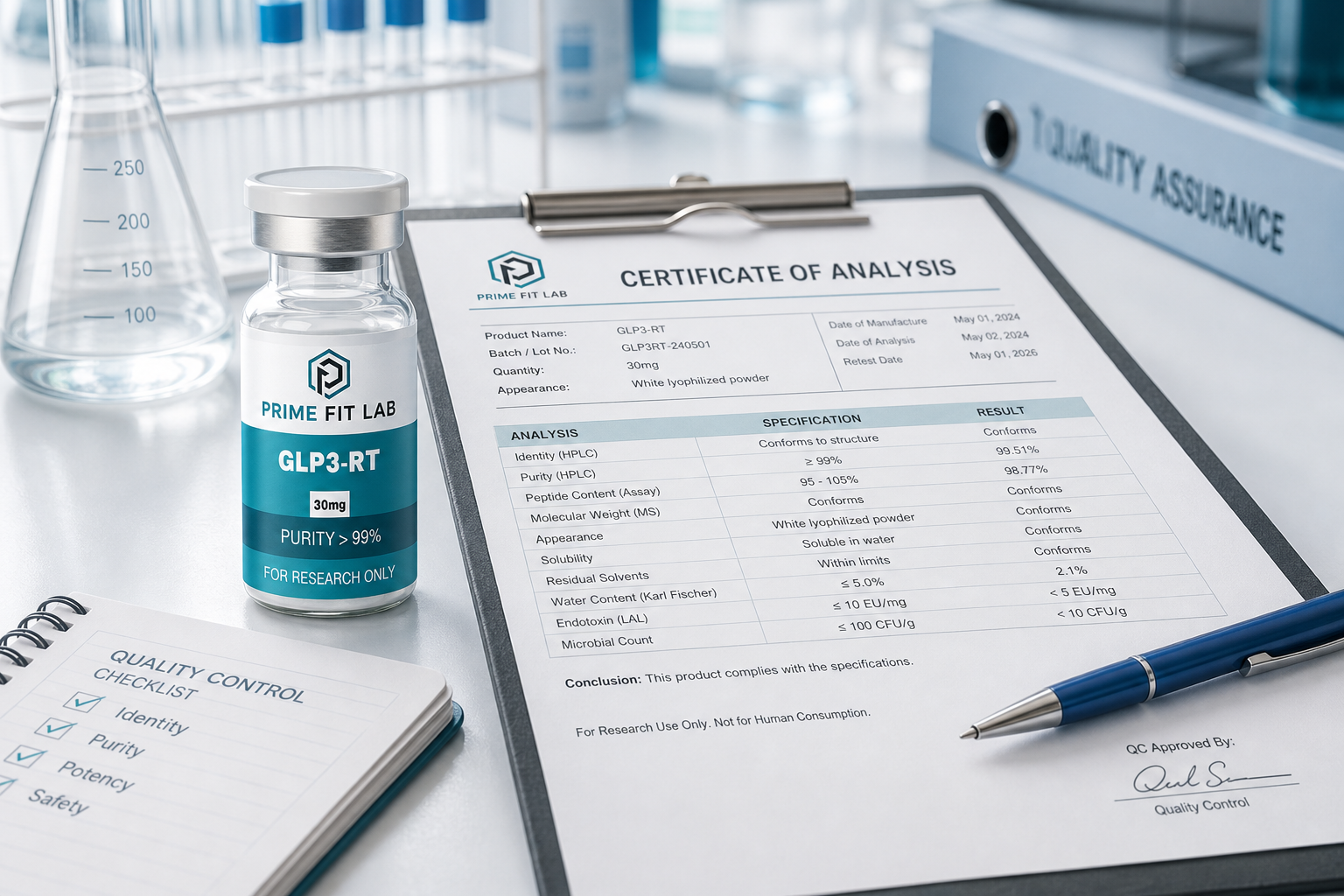
A peptide COA is only useful when it can be tied directly to the vial or product lot in front of you. A clean-looking PDF with a high purity number is not enough. To know how to read peptide COA documentation properly, start by confirming the lot number, then evaluate what was tested, how it was tested, and whether the reported result answers the right question for your research standard.
For experienced buyers, a Certificate of Analysis is not marketing copy. It is a quality-control record. Read it with the same discipline you would apply to the product label, stated quantity, storage requirements, and supplier documentation.
When applying this checklist, compare the certificate details available for CJC-1295 No DAC 10mg and BPC-157 10mg, then review the quality-testing process used across the catalog.
Start With the Product and Lot Match
The first check is simple and non-negotiable: the COA must identify the same material you are reviewing. Compare the product name, lot or batch number, and testing date against the vial label and the supplier's listing. If a COA shows results for BPC-157 lot PFL-24081, but the vial is marked PFL-24115, the document does not verify that vial.
A reliable COA should clearly identify the material tested. Depending on the laboratory and test scope, this may include the peptide name, lot number, sample ID, client reference, date received, date tested, and date reported. Minor formatting differences are normal. Missing identifiers are not automatically proof of a problem, but they reduce traceability.
Also check the stated quantity or sample description. A report may describe material as a white lyophilized powder, for example, while the retail listing identifies a 5 mg or 10 mg vial. Those descriptions can coexist, but the lot link must remain clear. A supplier should be able to connect the finished product lot to the test result without guesswork.
How to Read Peptide COA Identity Results
Purity and identity are related, but they are not the same result. A high-performance liquid chromatography, or HPLC, result can show the relative purity profile of a sample. It does not, by itself, fully establish that the major peak is the claimed peptide.
For identity confirmation, look for an appropriate analytical method such as mass spectrometry. Depending on the report, this may appear as MS, LC-MS, MALDI-TOF, molecular mass, observed mass, or calculated versus observed mass. The reported molecular weight should align closely with the expected molecular weight for the peptide and its stated form.
That last detail matters. Peptides may be presented as acetate, trifluoroacetate, or another salt form, and molecular-weight reporting can vary based on whether the counterion is included. A small difference is not necessarily a concern. The key is whether the report provides enough context to show that the laboratory identified the intended analyte rather than merely measuring a dominant unknown component.
For multi-compound blends, the documentation should be more specific. A single generic purity result may not establish the identity or proportion of every listed component. The appropriate level of testing depends on the blend, the analytical method, and what is claimed on the label. When several active compounds are present, clear component-level support is stronger than a broad statement that the blend was tested.
Read Purity Numbers in Context
The purity result is typically the number buyers look for first. You may see it reported as HPLC purity, area percent, assay, chromatographic purity, or a similar term. A stated 99%+ result generally means the tested sample showed a dominant chromatographic peak under the reported method.
Still, do not treat every percentage as interchangeable. HPLC area percentage is often a useful purity indicator, but it is not necessarily a quantitative confirmation that every vial contains the exact labeled milligram amount. Assay and content testing address a different question: how much target material is present. The distinction is especially relevant when comparing powders, blends, capsules, sprays, or products with added excipients.
Read the acceptance criteria beside the result. A well-structured COA commonly includes a specification and a result, such as purity not less than 99.0% and result 99.4%. This lets you see both the target standard and whether the tested sample met it. A result without a stated method or specification offers less practical context.
Be cautious with documents that display only a large purity percentage but omit the method, chromatogram, sample identification, or laboratory details. The number may be accurate, but the document gives you limited ability to evaluate it.
What a Chromatogram Can Tell You
Some COAs include an HPLC chromatogram. This is the graph showing detector response over retention time. In a straightforward reading, the main peak should be clearly dominant, with smaller peaks representing potential related substances, impurities, or background signal.
A chromatogram is useful supporting evidence, but it should not be overinterpreted without method details. Peak shape, retention time, detector settings, integration rules, and the selected column can affect the visual output. An unusually clean graph does not replace lot matching and identity confirmation. Likewise, small secondary peaks are not automatically disqualifying if the reported purity meets a defined specification.
Review the Method, Laboratory, and Dates
A COA should state who performed the work and how. Look for the testing laboratory name, report number, analyst or reviewer authorization where applicable, and a method reference. An independent third-party laboratory provides an additional layer of separation from the seller, though the value still depends on the lab's reporting quality and the scope of testing requested.
Method names may be abbreviated, but they should be recognizable. Common examples include HPLC or UPLC for purity profiling, LC-MS or MALDI-TOF for identity, and ICP-MS for elemental or heavy-metal screening. The relevant question is not whether every report uses every method. It is whether the methods used support the claims being made.
Dates deserve a close read. The manufacture date, test date, and report date can differ. A test performed after production but before release is common. A report issued months later may still be valid for the lot, provided the product is traceable and stored according to its requirements. What should raise questions is a COA with no date, no lot number, or documentation that appears to be recycled across unrelated inventory.
Know Which Contaminant Screens Matter
Contaminant testing is not one universal panel. A heavy-metal screen, residual solvent analysis, microbial test, endotoxin test, and sterility test each address different potential risks. Do not assume that a passing heavy-metals result proves a material is sterile, or that a high HPLC purity result proves it is free from residual solvents.
For research materials, the appropriate screening depends on the compound format, production process, and intended research protocol. A lyophilized peptide powder and a finished topical or liquid spray may require different documentation priorities. The strongest COA package is specific about what was tested and reports results against defined limits, rather than using vague language such as “passed” without a test name or measurement.
When heavy metals are listed, review the elements tested and the units reported, often ppm or parts per million. For microbial results, distinguish between total microbial count, yeast and mold, and specified organisms. For endotoxin, verify that the result is actually reported in endotoxin units and that the method is identified. If a category does not appear on the COA, do not assume it was included.
Separate a COA From a Product Claim
A COA supports a specific test result for a specific sample or lot. It does not convert a research-use-only product into an approved drug, establish suitability for human use, or replace controlled handling practices. It also does not justify therapeutic, diagnostic, or disease-related claims.
This is where disciplined purchasing matters. Evaluate the COA alongside the supplier's stated product standard, lot traceability, storage guidance, labeling, and fulfillment controls. A supplier that presents third-party testing and 99%+ purity standards should be able to make the documentation easy to inspect and easy to connect to the inventory being sold.
At Prime Fit Lab, the practical standard is direct: review the COA before ordering, confirm the lot when the product arrives, and retain the document with your research records. That process is faster than trying to resolve a documentation question after the fact.
A Fast COA Review Before Checkout
Before purchasing, verify four points: the product name and lot are traceable, identity testing is appropriate, purity is reported with a method and specification, and any claimed contaminant testing is shown rather than implied. Then check the report date and laboratory information.
If one of those points is unclear, treat the COA as incomplete documentation until the supplier can clarify it. The best COA is not the one with the biggest percentage at the top of the page. It is the one that gives you a clear, lot-specific chain from product label to tested result and supports a controlled research purchasing decision.