
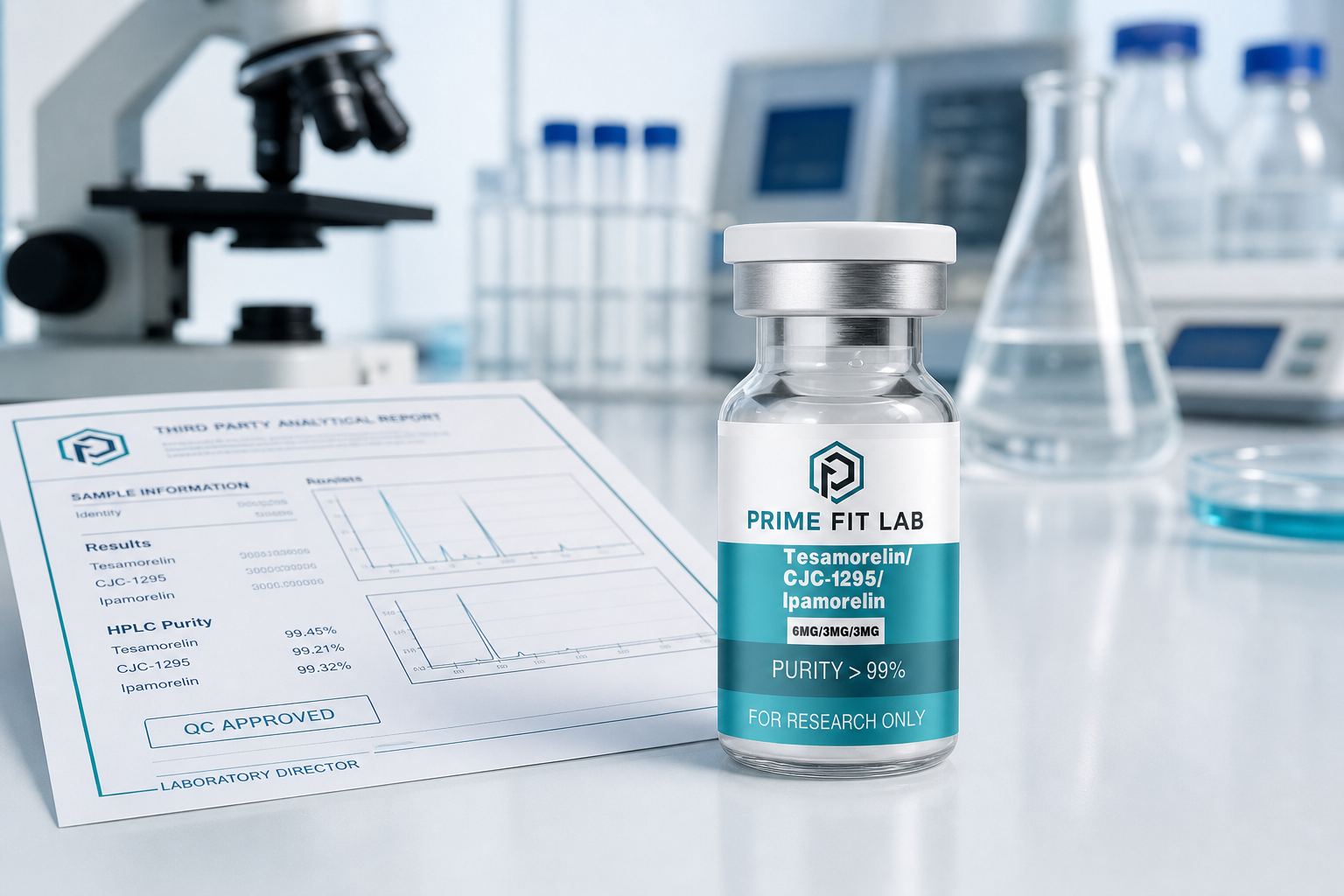
A 99%+ purity statement has value only when it is connected to documentation that can be reviewed, matched, and understood. For buyers sourcing third party tested research peptides, the meaningful question is not whether a product page uses the word “tested.” It is whether the available records establish a credible chain between the listed compound, the specific lot, the stated specification, and the material being shipped.
That standard matters because research compounds are not interchangeable simply because two labels carry the same name and milligram amount. Identity, purity, lot consistency, handling, and fulfillment controls all affect whether a purchaser can evaluate an item with confidence. A disciplined supplier makes those details visible rather than asking the buyer to rely on broad quality language.
What Third Party Tested Research Peptides Should Mean
Third-party testing refers to analysis performed by an independent laboratory rather than solely by the seller or manufacturer. The purpose is verification. An outside analytical result can help confirm whether a sample aligns with the compound identity and quality specifications presented for that lot.
Still, “third-party tested” is not a blanket conclusion. It does not automatically mean every possible quality attribute has been tested, nor does it make a research product approved for human or veterinary use. The value lies in the scope of the testing, the clarity of the results, and the ability to connect those results to the item in hand.
For research-use-only products, that distinction should remain firm. Testing documentation supports procurement and research-material evaluation. It does not create a diagnosis, treatment, cure, prevention, dosing, or administration claim.
Identity and Purity Are Separate Checks
Identity asks whether the material is the compound represented on the label. Depending on the material and testing approach, an analytical laboratory may use tools such as mass spectrometry or chromatographic methods to support that determination.
Purity asks how much of the tested sample is attributable to the target material relative to detectable impurities under the stated analytical method. A stated 99%+ purity standard is useful when the method, lot reference, and result are available for review. It is less useful when it appears as an unqualified number with no supporting record.
Neither category should be confused with safety for consumption. Research peptides are sold for scientific research use only, and a COA is a quality document, not a medical authorization.
The Certificate of Analysis Is the Practical Starting Point
A certificate of analysis, commonly called a COA, is where a quality claim becomes something a purchaser can inspect. It should be treated as a lot-specific document, not a decorative badge placed next to a product name.
The most useful COAs create a direct match between the documentation and the material offered for sale. That begins with a lot or batch number. If the product label references a lot, the COA should reference the same lot. A document that cannot be tied to the current inventory lot provides less decision value, even if the reported numbers look strong.
Review the issue date and test date as well. These dates help establish whether the document is current enough to be relevant to the inventory being evaluated. Exact expectations depend on the compound, format, storage conditions, and supplier’s lot-management process, but a clear date trail is always preferable to an undated report.
A complete COA should also identify the laboratory or analytical source, list the sample or product description, and report results in a readable format. Buyers should be able to distinguish a tested result from a generic specification. “Meets specification” can be appropriate when supported by the underlying data, but it should not substitute for all details when the product is promoted on testing transparency.
Documentation to Review Before You Purchase
When comparing third party tested research peptides across suppliers, focus on the records that reduce uncertainty around the exact item being ordered. The following details are especially useful:
- Compound and lot identification: The product name, concentration or fill amount where applicable, and lot or batch reference should align with the product listing and package label.
- Analytical method: The report should indicate how identity and purity were evaluated. Method context helps a knowledgeable buyer interpret what the result does and does not establish.
- Reported purity result: Look for a stated numerical result associated with the sample, rather than a broad marketing claim disconnected from a test record.
- Contaminant screening scope: If heavy-metal or other contaminant screening is claimed, the documentation should make clear what was screened and how the result was reported.
- Laboratory and date information: A named analytical source, report date, and sample traceability fields strengthen the usefulness of the document.
The right level of review depends on the project and the compound. A repeat purchaser who already knows the catalog may prioritize lot continuity and fast access to current COAs. A buyer evaluating a new supplier may spend more time examining how thoroughly the supplier presents identity, purity, and screening information. Both approaches are reasonable when the records are easy to locate and read.
Testing Claims Need Defined Boundaries
Quality language can become vague when different testing categories are grouped together. Purity testing, identity confirmation, heavy-metal screening, microbial testing, residual solvent testing, and sterility testing are distinct analytical concepts. A supplier should avoid implying that one type of result proves all the others.
This is where careful buyers separate evidence from assumptions. If a listing says it has been screened for contaminants, determine whether the documentation supports that exact claim. If the listing presents a purity percentage, confirm whether the COA identifies the related lot. If sterile status is not explicitly documented, it should not be inferred from a clean-looking vial, professional packaging, or a purity result.
Packaging also has limits. A sealed container, tamper-evident presentation, and clear labeling support organized inventory handling, but they are not replacements for analytical verification. The strongest procurement standard combines visible documentation with consistent product presentation and controlled order fulfillment.
A Reliable Supplier Process Goes Beyond the Lab Report
A COA is central, but it is not the only signal that matters. The purchasing experience should support traceability from product selection through delivery. Clear category organization, accurate format descriptions, secure checkout, order history, responsive support, and reliable shipping operations all reduce avoidable friction for repeat buyers.
For US purchasers, fulfillment speed can matter when coordinating research supplies and related materials. But fast shipping should not displace documentation review. A supplier that can provide both current COA access and efficient order processing gives buyers a more dependable operating experience than one that excels at only one of those functions.
Prime Fit Lab centers its catalog around stated third-party testing, 99%+ purity standards, contaminant and heavy-metal screening claims, COA access, secure checkout, and same-day shipping support for eligible US orders. Those are the right categories to evaluate, provided each purchase is reviewed against the specific listing and lot documentation available at the time of order.
Red Flags That Deserve a Second Look
Some gaps do not prove a product is inadequate, but they should slow down a purchasing decision. A testing claim with no accessible COA, a report with no lot number, an unexplained mismatch between the listed product and test document, or a purity percentage without method context all limit a buyer’s ability to assess the material.
The same is true of extreme certainty. Research-material sourcing involves practical limits, and credible suppliers communicate the scope of their testing rather than using language that suggests a report answers every possible question. Specificity is generally more valuable than superlatives.
Buyers should also watch for product pages that blur research-use-only boundaries. A reputable research-compound retailer can describe testing, format, storage guidance supplied by the manufacturer, and order logistics without making health, performance, or therapeutic promises. Clear boundaries are part of professional quality control.
Build Your Standard Around Verifiable Details
The best purchasing habit is simple: verify the material, the lot, the report, and the scope of the claim before adding an item to the cart. Third-party testing earns its value when it is documented clearly enough for an informed buyer to inspect, compare, and revisit on the next order.
For research-use-only procurement, that level of discipline is not extra paperwork. It is the baseline for purchasing with confidence.