
Research Compound Capsule Formats Explained
July 26, 2026
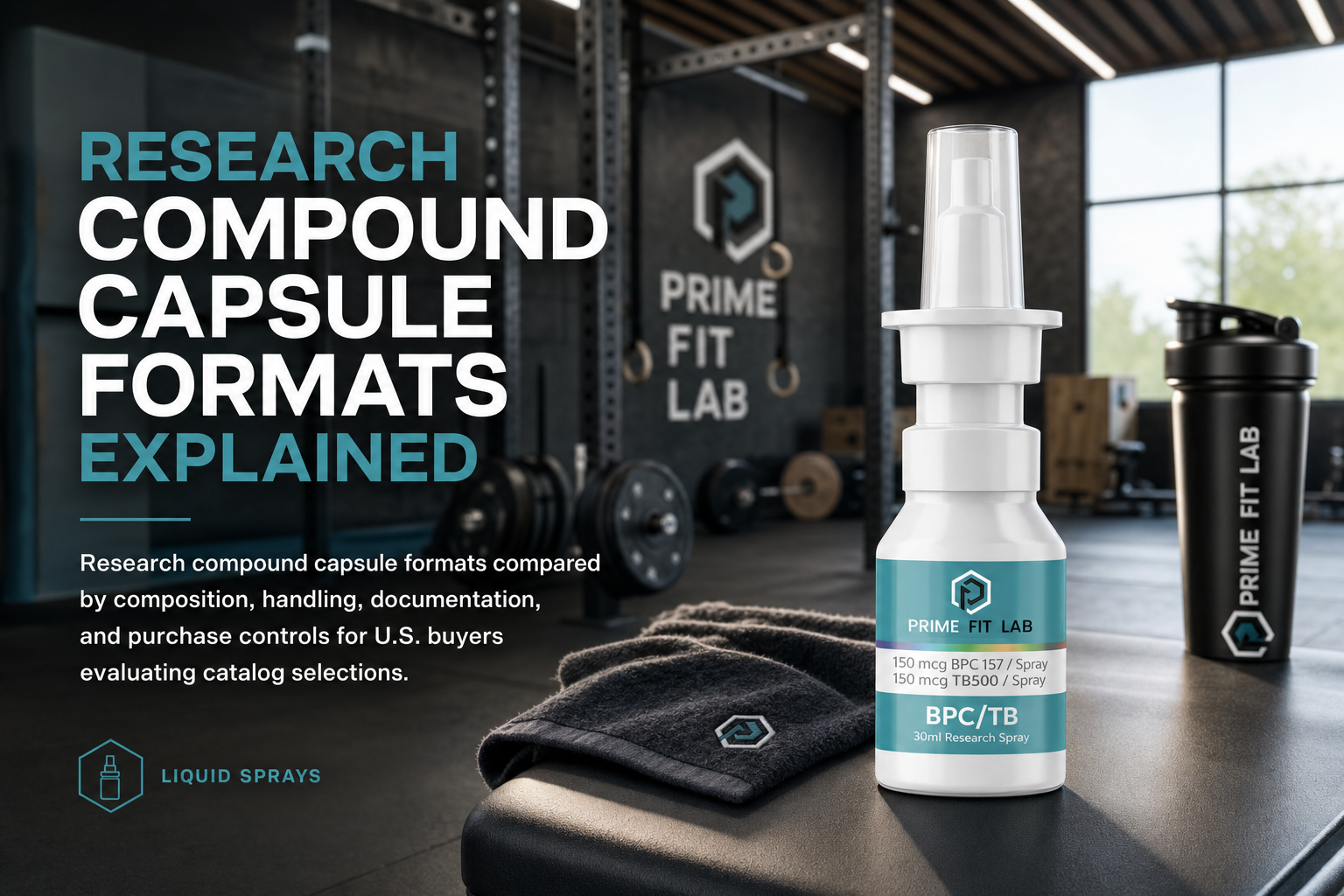
Research compound capsule formats solve a different purchasing problem than lyophilized peptides, liquids, sprays, or topicals. For buyers who prioritize a fixed, pre-measured presentation and straightforward catalog comparison, capsules can reduce handling variables at the product-selection stage. The format still requires the same discipline expected across any research-use-only purchase: verify the listing, review available documentation, confirm strength and quantity, and keep the intended research boundary clear.
Capsules are not a universal replacement for other formats. They are a format choice with specific advantages, limitations, storage considerations, and documentation questions. A dependable comparison starts with the finished product, not just the compound name on the label.
What Defines Research Compound Capsule Formats
A capsule is a unit-dose presentation in which a measured amount of one compound, or a defined blend of compounds, is enclosed in a shell with supporting excipients. The exact shell type, capsule size, inactive ingredients, fill weight, and amount of active material can differ between products. Those details matter because two listings with similar names may not be directly comparable.
For research-oriented buyers, the primary convenience is consistency of presentation. Rather than working from a vial or measuring a liquid, the product is organized in discrete units. That makes inventory management and format-level comparison more direct, especially when reviewing total capsule count alongside the labeled amount per capsule.
The limitation is equally clear: a capsule is a finished presentation. Its contents, ratio, and unit amount are fixed by the manufacturer. If a project requires a different compound ratio, a different format, or separate components for controlled comparison, a capsule may not be the appropriate catalog choice.
Single-Compound Capsules vs. Blends
Single-compound capsules offer a cleaner product definition. The label should make it easy to identify the named compound, amount per capsule, capsule count, and total product content. This presentation can simplify recordkeeping because there are fewer variables in the formula.
Blended capsules place multiple listed compounds into one finished unit. They are useful when the research objective calls for the stated combination, but they require closer label review. A buyer should assess each listed component, the amount of each component, and whether the product documentation applies to the finished blend or only to a source ingredient. A blend with an impressive total milligram number is not automatically more suitable than a lower-total product with clearly stated component amounts.
How to Compare Capsule Listings Without Guesswork
The most efficient comparison is not based on product name, price, or capsule count alone. Start by matching like with like. Compare the amount per capsule, number of capsules per container, total labeled compound amount, and whether the listing is a single compound or a blend.
A 30-capsule container and a 60-capsule container cannot be compared meaningfully until the unit amount is established. Likewise, a product labeled with a total blend weight needs a closer look than one that identifies each active component separately. Clear labeling is operationally useful because it supports repeat ordering and minimizes avoidable catalog errors.
The capsule shell and inactive ingredients also deserve attention. Excipients can influence fill characteristics, stability, flow during manufacturing, and product presentation. For buyers working under defined material preferences or project constraints, those details should be treated as product specifications rather than footnotes.
Read the Strength in Context
Strength should be read as a complete statement. “X mg” may refer to the amount per capsule, the total amount per bottle, or a combined amount across a blend. The listing should make the basis obvious. If it does not, the product is harder to compare and harder to document.
Total content is useful for planning purchase quantities, while per-capsule content is useful for evaluating the unit presentation. Both figures belong in a disciplined purchasing review. Neither one, by itself, establishes quality or suitability.
Price should also be evaluated against the labeled total content and documentation level, not used as a standalone quality signal. An unusually low price can be a reason to ask more questions, but a higher price is not proof of better material. Product clarity, testing support, and supplier controls carry more weight than marketing language.
Documentation Is the Quality Checkpoint
For capsule products, purity claims should be supported by accessible, product-relevant documentation. A certificate of analysis can provide a useful reference point, but the buyer should confirm what exactly was tested. Documentation for a raw input is not necessarily the same as documentation for the finished capsule product.
A practical review may include identity confirmation, assay or purity information where applicable, lot reference, test date, and screening information relevant to the supplier’s stated quality controls. For a finished capsule, consistency of the final presentation matters alongside the identity of the underlying compound. The more clearly a supplier distinguishes raw-material testing from finished-product testing, the easier it is to evaluate the claim.
Prime Fit Lab presents third-party-tested status, stated 99%+ purity standards, contaminant and heavy-metal screening claims, and COA access as core purchase controls. Buyers should still review the documentation associated with the specific item and lot when available. “Tested” is a useful starting point, not a substitute for reading the product record.
Lot Traceability Matters for Repeat Orders
Repeat purchasing works best when product records are organized. Retain the product name, stated strength, quantity, lot details if provided, order date, and relevant documentation. This creates a cleaner comparison when a later order is placed or when catalog packaging changes.
Lot traceability is particularly valuable when evaluating consistency over time. It helps separate a meaningful product change from a simple label refresh and gives buyers a factual record to reference if they need clarification from the supplier.
Storage and Handling Are Part of the Format Decision
Capsules are often selected because they avoid reconstitution and can be easier to count, store, and organize than some alternative formats. That does not mean they are maintenance-free. The supplier’s storage instructions control. Heat, moisture, direct light, and unnecessary exposure after opening can affect capsule shells and finished materials.
Keep the product in its original, labeled container whenever possible. The original packaging carries the lot and product identification needed for proper inventory control. Transferring capsules into unmarked organizers may look convenient, but it weakens traceability and increases the chance of mix-ups between similar products.
Avoid assuming that all research compounds have identical storage requirements simply because they share a capsule format. The underlying material and formulation determine the appropriate handling conditions. If a listing provides specific storage guidance, follow that guidance rather than applying a general rule from another product category.
When Capsules Are the Better Catalog Choice
Capsules are generally the stronger fit when the priority is a fixed unit presentation, uncomplicated inventory counting, and a clearly labeled finished product. They may also suit buyers who want to compare several catalog options by per-capsule amount and total container content without introducing liquid measurement or reconstitution variables.
Other formats may be a better fit when the research requirement centers on a format-specific property, separate materials, or a product not available as a capsule. The right answer depends on the actual product specification, not a blanket preference for convenience. Format should follow the research need, then be verified against documentation and handling requirements.
Purchase Controls Before Checkout
Before placing an order, confirm the exact product name, format, listed strength, capsule count, and current documentation. Review the supplier’s research-use-only statement and make sure the purchase is consistent with that restriction. Research compounds are not intended to diagnose, treat, cure, or prevent disease, and they are not a substitute for medical products or medical advice.
Then review fulfillment details with the same care used for product details. Secure checkout, clear order records, reliable U.S. shipping, and responsive support all reduce friction when purchasing a specialized catalog item. For repeat buyers, account-based order history can be as useful as the label itself.
The strongest capsule purchase is rarely the one with the loudest claim. It is the one whose format, labeled contents, documentation, and fulfillment controls are easy to verify before it reaches your inventory.